













Collingwood PIR Sensor for Area Bay Luminaires

Pay in 3 with Klarna
Rated five stars by thousands of customers since 2014 - see our full review history here

5 Years Warranty

Hassle-Free Returns

20+ Years of Experience

Free UK Delivery*
The part that stops a high bay burning energy over an empty aisle
The Collingwood HBPIR is a passive infrared motion sensor with a daylight threshold switch, built to do one job well. It turns an Area Bay high bay luminaire into a fitting that responds to people rather than running flat out all shift. There is no separate control wiring to pull in and no gear tray to find room for. The sensor pushes into the Zhaga socket in the middle of the luminaire and twists to lock, and Collingwood quotes under three seconds to fit one.
The sensor itself
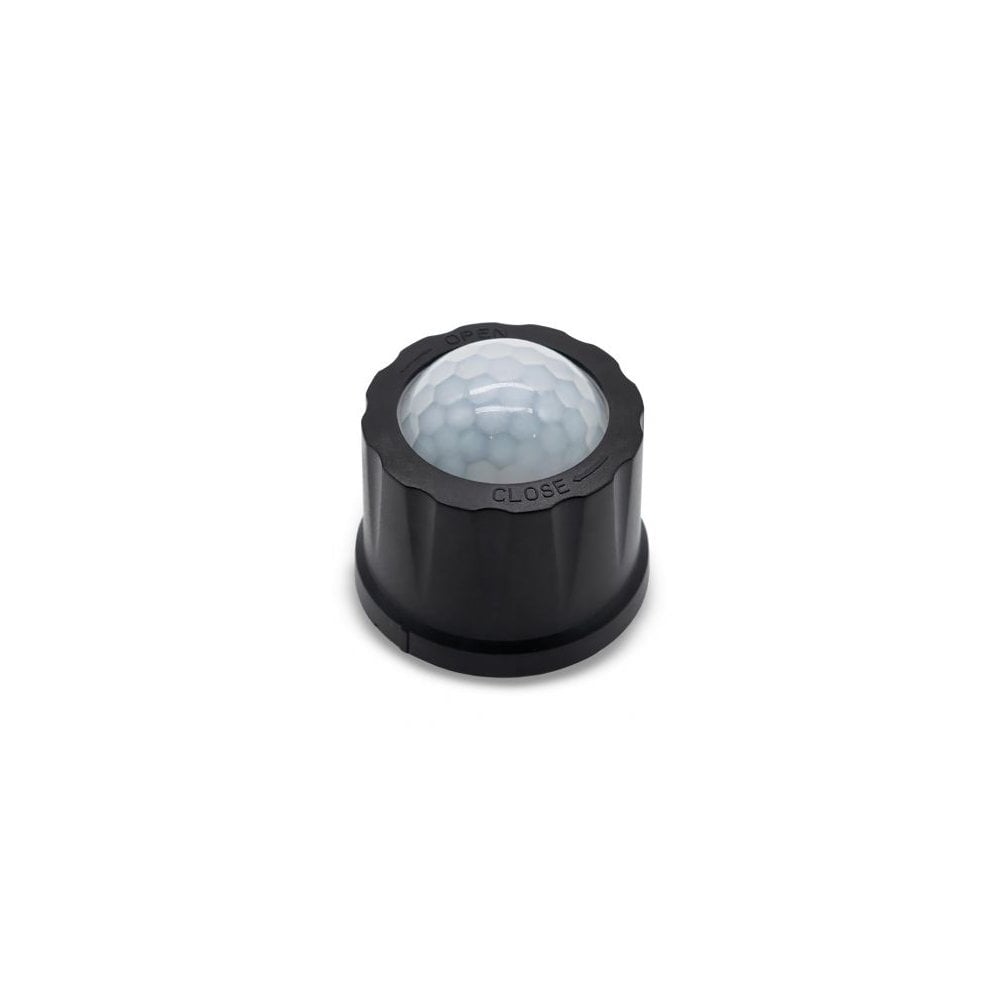
It is a squat moulded black body with a ridged collar marked OPEN and CLOSE, which is the twist action that locks it into the socket. The white faceted dome sitting on top is the Fresnel lens, and that is what gives a PIR its detection pattern. The whole thing weighs 0.1 kg, so it adds nothing worth thinking about to a jack chain or a rod mount. It is made for the Collingwood Area Bay, and Collingwood also lists it as an accessory across the Rack Bay high bay range.
How It Works
A passive infrared sensor reads changes in heat moving across its field of view, so it triggers on a person walking into the zone rather than on ambient warmth. When it sees movement it brings the luminaire up. When movement stops, the hold time decides how long the light stays up before anything changes, and that is settable from 30 seconds through to 30 minutes.
After the hold time expires you have a choice. Standby dimming drops the luminaire to 10, 20, 30 or 50 percent instead of going dark, which keeps a working level of light in the aisle for safety. A standby period can then be set on top of that, from 10 seconds up to 30 minutes, after which the luminaire switches off properly. The daylight threshold is a separate control again, adjustable from 2 lux up to 400 lux, and it stops the light coming on at all when there is already enough natural light in the space. It ships with the threshold disabled, so you enable it if you want it. Detection sensitivity is adjustable too, which is how you stop one sensor picking up traffic in the next aisle over.
Setup happens from floor level with a handheld Collingwood commissioning remote, which is a separate purchase and is not supplied with the sensor. You dial the settings into the first luminaire, save them, then send the same set to every other fitting on the run without going up a ladder again. Dimming is carried over 0-10V and PWM.
Where It Works Best
This is a sensor for commercial high bay installations. Collingwood gives a typical installation height of 8 to 13 metres and a maximum recommended mounting height of 13 metres, which puts it squarely in warehouses, distribution centres, storage racking, workshops and production halls where the fitting hangs well above head height. PIR is the right pick over microwave when the sensor has clear line of sight down an aisle, and it is the safer pick in buildings with vibration from plant or vehicles, because it will not nuisance trigger the way a microwave head can. Microwave earns its place instead in open areas and where the sensor has to see round obstructions.
One sensor per luminaire gives you individual control, so only the bay someone is actually working under comes up to full. Link the fittings on a 0-10V control line and you get group behaviour instead, holding a low level across the whole space so nowhere goes fully dark. At IP65 the sensor is sealed against dust and protected against water jets from any direction, which is more than the IP44 minimum applied in bathroom lighting zones, though in practice this is an industrial accessory rather than a domestic bathroom product.
About Collingwood Lighting
Collingwood designs and manufactures its LED products in Sywell, Northamptonshire, and has worked in LED technology and nothing else since 2002. That long focus is why the sensor range is this tightly matched to the luminaires, down to the socket. The brand states it was among the first to put fire rated, fully sealed for life and mains dimmable LED products into the UK electrical wholesale market. Collingwood also holds an EcoVadis Gold medal, which places it in the top five percent of companies assessed worldwide for sustainability.
Good to Know
- Five year Collingwood warranty.
- IP65 rated, meaning fully protected against dust and against water jets from any direction.
- Fits the Zhaga socket at the centre of the luminaire. No tools needed, push and twist.
- Hold time options run 30 seconds, 1, 3, 5, 10, 20 and 30 minutes. Standby dimming holds at 10, 20, 30 or 50 percent. Standby period options run 10 seconds, 30 seconds, 1, 5, 10 and 30 minutes.
- Daylight threshold is adjustable from 2 lux to 400 lux and is disabled as supplied.
- Dimming is supported over 0-10V and PWM.
- A Collingwood commissioning remote is required to change any of the settings and is sold separately.
- Weight 0.1 kg.
- Keep the lens clear. Dust build up on the dome in a dirty environment will blunt detection, so wipe it with a dry cloth when the luminaire is serviced.
- Moonlight Design recommends installation by a registered NICEIC electrician.
Questions People Ask
Do I need anything else to set up the Collingwood HBPIR sensor?
Yes. The Collingwood HBPIR is configured using a handheld commissioning remote that is sold separately and is not included with the sensor. Settings are sent to the luminaire from floor level, then copied to the remaining fittings on the run.
What is the maximum mounting height for the Collingwood HBPIR?
Collingwood gives the HBPIR a typical installation height of 8 to 13 metres and a maximum recommended mounting height of 13 metres.
Does the HBPIR switch the light off completely, or dim it down?
Either. The Collingwood HBPIR can hold the luminaire at a standby level of 10, 20, 30 or 50 percent so the space never goes fully dark, and a standby period of up to 30 minutes can be set after that to switch the fitting off.
What is the difference between the HBPIR and the HBPIRDLD?
The Collingwood HBPIR is a PIR motion sensor with a daylight threshold switch, which simply blocks the light from coming on when natural light is already above a set lux level. The HBPIRDLD is a PIR sensor with daylight harvesting, which adjusts luminaire output in response to the daylight available.
Which luminaires does the Collingwood HBPIR fit?
The HBPIR plugs into the Zhaga socket at the centre of Collingwood Area Bay luminaires, and Collingwood also lists it as a compatible accessory for its Rack Bay high bay range.
We offer free standard delivery on orders within the UK Mainland* (an additional fee applies for the Isle of Wight, the Isle of Man, the Scottish Isles, parts of Scotland, Northern Ireland, the Republic of Ireland, the Channel Isles and International).
*Collingwood orders under £150 incur a delivery fee of £9.95 inc. VAT.
*Any order under £49 incurs a delivery fee of £9.95.
Specifications
What Our Customers Say About Us