













Choosing a bathroom light should be simple. Then you spot the small print about zones and IP ratings, search for a diagram, and end up more confused than when you started. Many of the diagrams online still show a zone that was removed from the regulations back in 2008, and some recommend ratings you cannot actually buy.
This guide fixes that. Everything here is based on BS 7671, the IET Wiring Regulations (18th Edition), which set the national standard for electrical installations in UK bathrooms. By the end you will know exactly which IP rating to buy for every part of your bathroom, with no guesswork at all.
The quick answer
| Zone 0 | Inside the bath or shower | IP67 or higher |
| Zone 1 | Above the bath or shower, up to 2.25m from the floor | IP65 recommended (IPX4 is the legal minimum) |
| Zone 2 | Within 60cm of the bath, shower or basin, up to 2.25m high | IP44 or higher |
| Outside the zones | Everywhere else in the bathroom | No set minimum, IP44 is a wise choice |

What are bathroom lighting zones?
Bathroom lighting zones are areas of your bathroom defined by how close they are to water. The closer a light fitting is to the bath or shower, the more water resistant it must be. The Wiring Regulations split the room into Zone 0, Zone 1, Zone 2 and everything else, which is simply called outside the zones.
The logic is easy to picture. A light inside a shower gets soaked. A light directly above the bath gets steam and splashes. A light on the far wall barely gets misty. Each of those situations needs a different level of protection, and that protection is measured with an IP rating.
What does an IP rating actually mean?
IP stands for Ingress Protection. Every rating is the letters IP followed by two digits. The first digit tells you how well the fitting keeps out solid objects like dust. The second digit tells you how well it keeps out water, and for bathrooms this second digit is the one that matters.
| Second digit | Protection against water |
| 4 | Splashes from any direction |
| 5 | Low pressure water jets |
| 6 | Powerful water jets |
| 7 | Temporary immersion up to 1 metre |
| 8 | Continuous immersion beyond 1 metre |
So an IP44 light shrugs off splashes, an IP65 light is sealed against dust and can take water jets, and an IP67 light can survive being submerged. Sometimes you will see an X in place of the first digit, as in IPX4. That simply means the solids rating has not been stated, and only the water rating is being specified.
Zone 0: inside the bath or shower (IP67)
Zone 0 is the interior of the bath tub or the shower tray itself. Any light installed here will be submerged or drenched, so it must be a low voltage fitting (12V SELV) rated at least IPX7, which in practice means buying IP67 or IP68. These are specialist lights, most often tiny recessed fittings used for a spa style effect. Most bathrooms have no lighting in Zone 0 at all, and that is perfectly fine.
Zone 1: above the bath or shower (IP65 recommended)
Zone 1 is the space directly above the bath or shower, up to 2.25 metres from the floor. This is where recessed downlights over a shower usually sit.
The regulations require a minimum of IPX4 here, rising to IPX5 if the bathroom is cleaned with water jets. So why does everyone recommend IP65? Because an IP65 fitting is sealed against dust and steam as well as water jets, it costs barely any more, and it removes all doubt. Nearly every downlight sold for shower use is IP65 for exactly this reason. If you see older guides insisting on IP45, ignore them. It is not a rating you will find on real products, and it is not what the regulations ask for.
One more rule for Zone 1: mains voltage fittings here must be protected by a 30mA RCD, and in modern installations the whole bathroom circuit will be RCD protected anyway. Your electrician will confirm this on the day.

Zone 2: within 60cm of water (IP44)
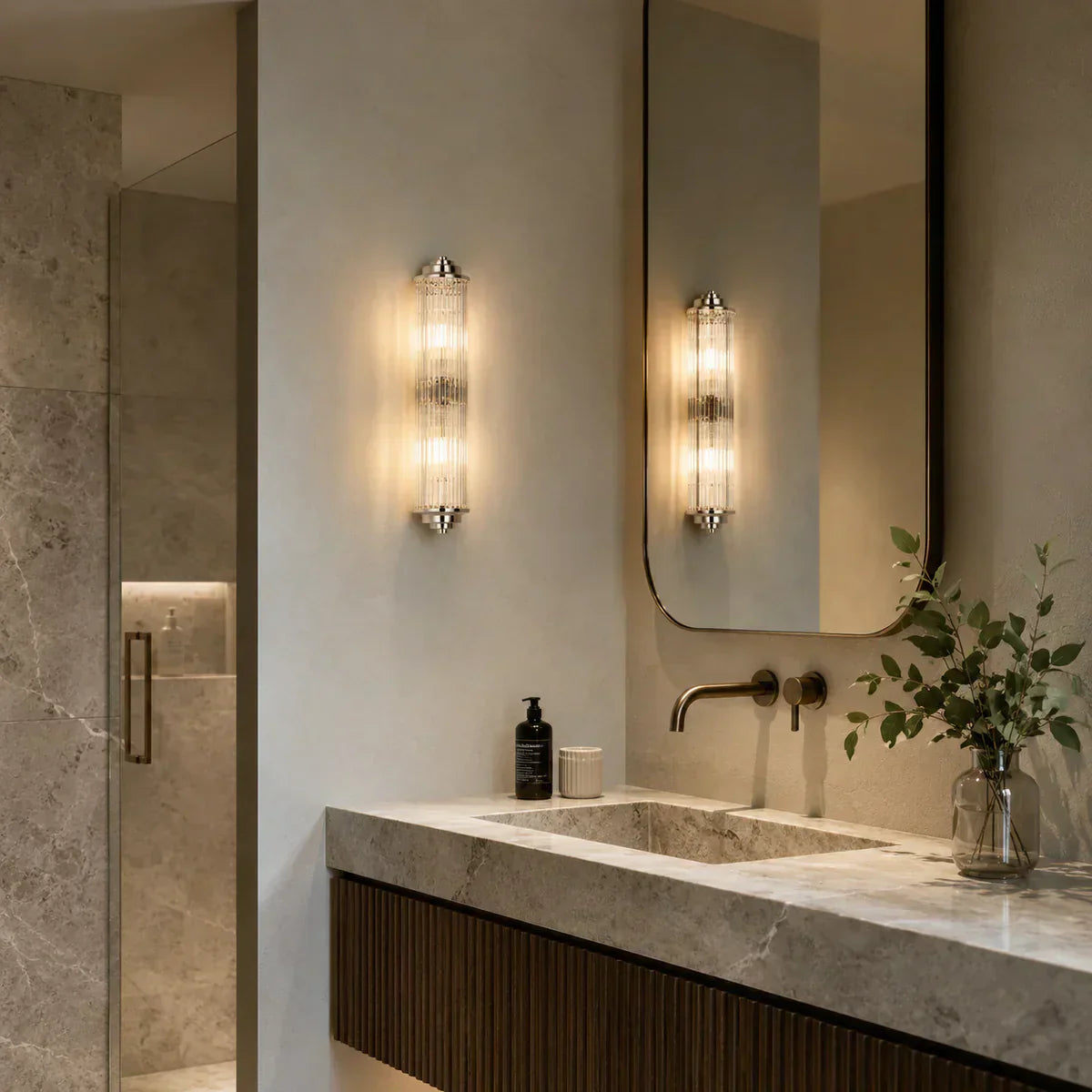
Zone 2 stretches 60cm beyond the edge of the bath or shower, up to a height of 2.25 metres. This is the classic home of the bathroom wall light, the light beside the mirror and the fitting above a basin.
The minimum here is IPX4, so an IP44 rated light is exactly right. Strictly speaking, the regulations only define zones around baths and showers, not basins. The sensible convention, and the one we follow, is to treat anything within 60cm of the basin taps as Zone 2 and choose IP44 there too.
This is the zone where you have real freedom of style. Our bathroom wall lights collection is full of IP44 designs, from traditional polished brass to modern matte black.
Outside the zones: the rest of the bathroom
Anywhere beyond Zone 2, and anywhere above 2.25 metres, sits outside the zones. There is no minimum IP rating here, so in theory an ordinary fitting is allowed. In practice, bathrooms are steamy places, and steam finds its way everywhere. Choosing IP44 throughout the room protects your lights, extends their life and means you never have to think about it again.
Whatever happened to bathroom Zone 3?
If you have seen diagrams showing a Zone 3, they are out of date. Zone 3 was removed from the Wiring Regulations in 2008, when the 17th Edition replaced it with the simpler idea of outside the zones. The 18th Edition, current today, keeps that approach. Any guide still showing Zone 3, or recommending IP20 for it, is working from rules that are nearly two decades old.
Is IP44 enough for a bathroom?
Yes, for most of it. IP44 is fully compliant in Zone 2 and everywhere outside the zones, which together cover the vast majority of any bathroom. The only places IP44 is not the answer are directly above the bath or shower, where IP65 is the smart buy, and inside the bath or shower, where you need IP67 or higher.
What lights can go above a shower?
Recessed downlights rated IP65 are the standard choice for the space above a shower. They sit flush with the ceiling, they are sealed against steam and water jets, and they meet the Zone 1 rules with room to spare. Pendants and exposed fittings do not belong above a shower unless they are specifically rated and installed for Zone 1, which is rare.
Do I need an electrician for bathroom lights?
Bathroom electrics are classed as special location work under Part P of the Building Regulations in England and Wales, and all bathroom circuits must have 30mA RCD protection. A registered electrician will handle the certification as part of the job. It is not the place to test your DIY courage, and a professional install usually takes less time than you would expect.
Shop bathroom lighting by zone
Every light in our bathroom lighting collection is designed for bathroom use, and the IP rating is listed on each product page so you can match it to your zone in seconds. And once you know your zones, our bathroom lighting guide covers the rest of the decision: styles, finishes and light quality. Here are three favourites for Zone 2, all IP44 friendly styles for walls and ceilings.


Whatever your style, check the IP rating on the product page against the quick answer table at the top of this guide and you cannot go wrong. If you are ever unsure, our team is happy to help at sales@moonlightdesign.co.uk.
Related reading:

Leave a comment
This site is protected by hCaptcha and the hCaptcha Privacy Policy and Terms of Service apply.