










Collingwood Salvus Route High Performance Emergency Spot - Black

Pay in 3 with Klarna
Rated five stars by thousands of customers since 2014 - see our full review history here

4 Years Warranty

Hassle-Free Returns

20+ Years of Experience

Free UK Delivery*
A recessed emergency downlight that stays out of the way until it is needed
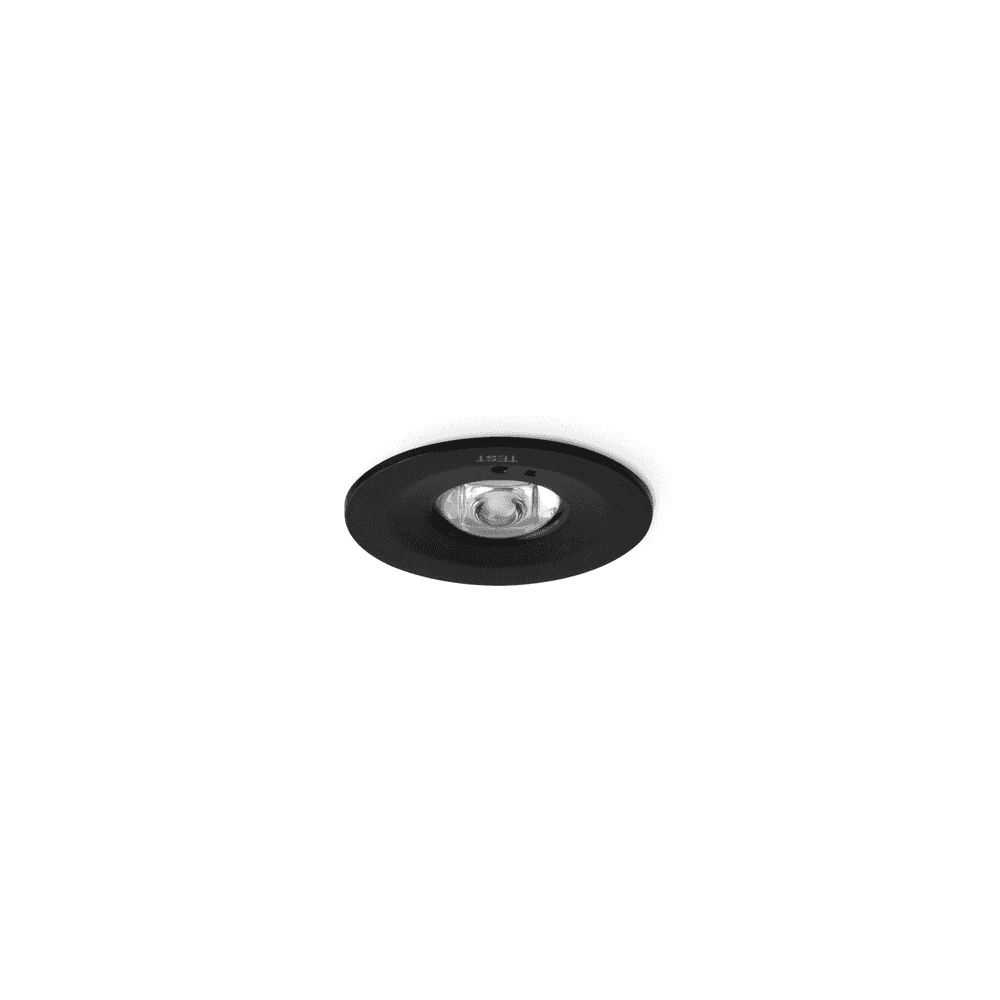
The Salvus Route is a recessed emergency spot that sits almost flush in the ceiling and does nothing visible until the mains supply drops. At that point the LED lights the escape route from its own battery. It draws just 1W, and Collingwood rates the efficacy at 130 lumens per watt, which is how a fitting this small can cover a serious amount of floor. Two lenses come in the box, so the same spot can be set up for an open area or for a corridor without ordering a different product.
The black finish
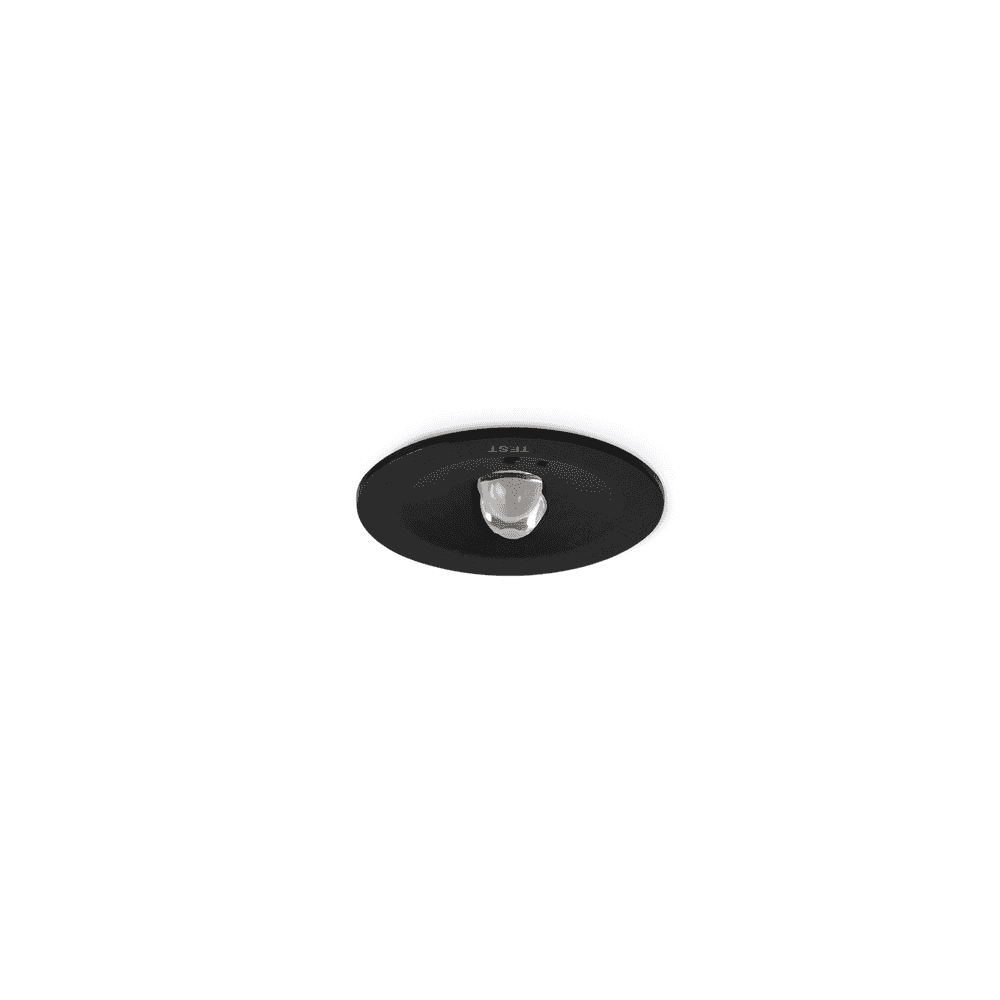
This is the black version. The body and bezel are moulded polycarbonate in a flat, low sheen black, and the whole fitting weighs only 180g. Against a dark ceiling grid, an anthracite soffit or a black painted plant room it more or less vanishes. Set into a white ceiling it becomes a small deliberate dot, which is usually the point in schemes that already run black downlights, black track heads and black ventilation grilles. The visible face measures 50mm across and the fitting is 24mm deep, so it lines up neatly with the small aperture downlights it will usually sit alongside.
How It Works
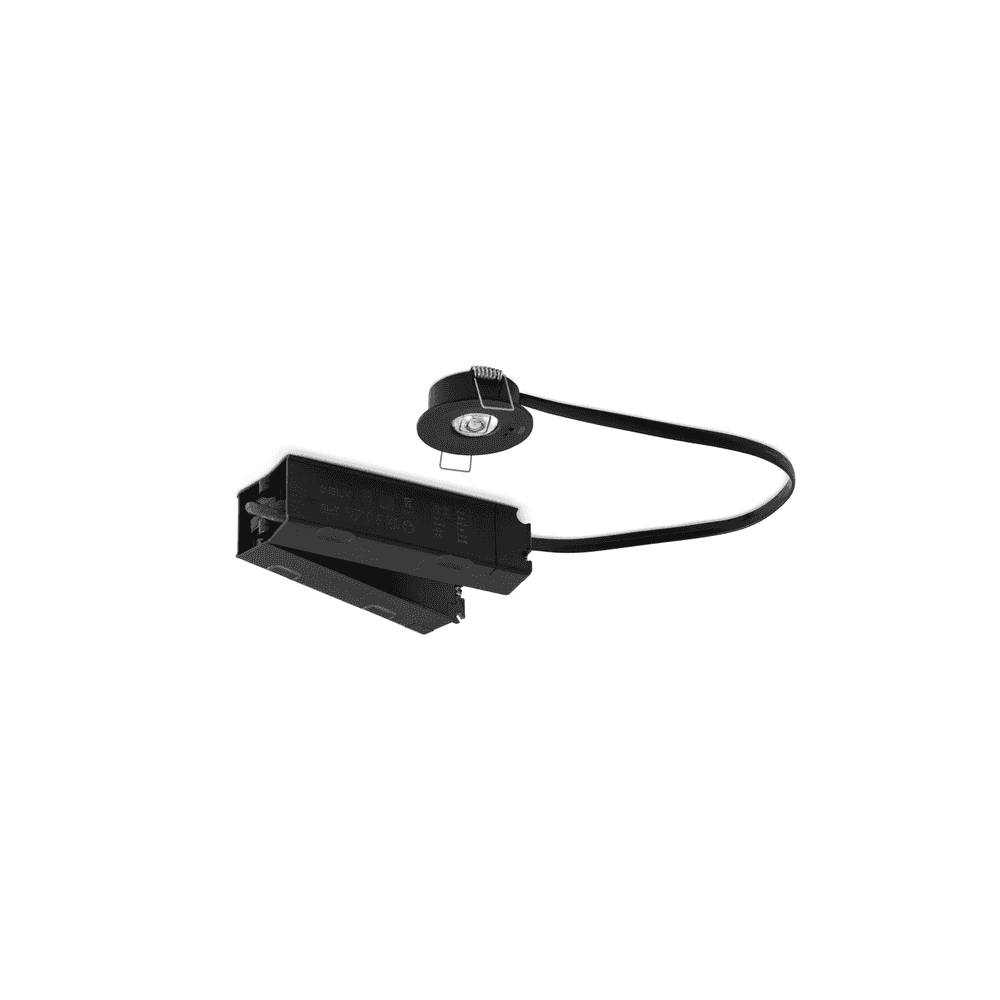
The spot runs straight off a 220 to 240V AC mains supply with no separate LED driver in the circuit. It keeps a LiFePO4 3.2V 1500mAh battery topped up, held in a slim remote compartment on a 300mm flying lead of H03VVH2-F 2 x 0.75mm² cable. Integrated loop in and loop out terminals carry the supply from one fitting to the next, so a run of spots wires in parallel without a junction box at every position. Cut a hole of 43mm to 44mm, push the battery compartment up into the void, and the sprung steel clips pull the bezel tight against the ceiling.
Both lenses are supplied and they are interchangeable on site. The open area lens gives a wide spread of 165 degrees. The corridor lens gives an elongated beam of 160 degrees by 50 degrees, which runs the light along a passageway rather than throwing it at the walls. Collingwood quotes spacings of up to 17 metres. Choose EMRBMAN if you want to test using the button on the bezel, or EMRBST if you want the fitting to run its own test cycle and report through the status LED on its face. Either version can be commissioned in maintained or non maintained mode.
Where It Works Best
This is a commercial fitting first. It belongs in offices, school and college corridors, retail floors, hotel landings, stairwells and back of house routes, anywhere the escape path has to stay lit when the power fails and nobody wants a plastic bulkhead box on the wall ruining the ceiling line. Because it recesses, it can be laid out on the same grid as the general downlights, so the emergency layer reads as part of the scheme rather than something bolted on afterwards. It also earns its place in larger homes and converted buildings with long hallways, basement stairs or a plant room where an emergency point is required. It is rated IP20 and IK04, so it is for dry indoor positions, and the ambient temperature around it should sit between 5 and 45 degrees Celsius.
About Collingwood Lighting
Collingwood designs and manufactures its LED products in Sywell, Northamptonshire, and has specialised in LED technology since 2002. The brand states that it was among the first to bring fire rated, fully sealed for life and mains dimmable LED products to the UK electrical wholesale market. Collingwood has also been awarded an EcoVadis Gold medal, which places it in the top 5 percent of companies assessed for sustainability worldwide.
Good to Know
- Warranty is 4 years. Collingwood's own emergency guide splits this as 4 years on the electronics and 2 years on the battery.
- IP20 rated, which means it is protected against solid objects and fingers but has no protection against water. Keep it in dry indoor positions.
- Class II construction, so the fitting is double insulated and needs no earth connection at the terminal.
- Wiring is parallel, through integrated loop in and loop out terminals and a 300mm flying lead.
- Output is a fixed 6500K daylight white with a CRI above 80. That cool, high contrast light is deliberate for emergency use. It is not dimmable and it is not colour switchable.
- Ceiling cut out is 43mm to 44mm. Overall size is 50mm diameter by 24mm deep, plus the remote battery compartment in the void above.
- Both the open area lens and the corridor lens are included, and either can be fitted or swapped later.
- Clean the bezel and lens with a dry, soft cloth only. Avoid solvents and cleaning sprays near the optic.
- Emergency lighting has to be tested and logged on a regular basis. The EMRBST self test version carries out the test itself, but the records are still your responsibility.
- Moonlight Design recommends installation by a registered NICEIC electrician.
Questions People Ask
What is the difference between the manual test and self test versions of the Collingwood Salvus Route?
The Collingwood Salvus Route EMRBMAN is the manual test version, checked using the test button on the face of the bezel, while the EMRBST is the self test version, which runs its own test cycle automatically and reports the result through the status LED. Both versions share the same 1W LED, the same pair of lenses and the same 50mm polycarbonate body.
What size hole does the Collingwood Salvus Route emergency spot need?
The Collingwood Salvus Route emergency spot needs a ceiling cut out of 43mm to 44mm. The visible bezel is 50mm in diameter and the fitting itself is 24mm deep, with a separate battery compartment on a 300mm flying lead that is pushed up into the ceiling void.
Should I use the open area lens or the corridor lens?
The Collingwood Salvus Route is supplied with both lenses. The open area lens gives a 165 degree spread and 130 lumens, which suits rooms and open floor plates. The corridor lens gives an elongated 160 by 50 degree beam and 120 lumens, which suits passageways and stairs. The lenses are interchangeable, so the decision can be made or changed on site.
Does the Collingwood Salvus Route need a separate driver?
No. The Collingwood Salvus Route runs directly from a 220 to 240V AC mains supply with no separate LED driver required. It uses integrated loop in and loop out terminals so a run of fittings can be wired in parallel, and it charges an onboard LiFePO4 3.2V 1500mAh battery that powers the LED if the supply is lost.
Can the Salvus Route be used as a normal light as well as an emergency light?
Yes. In maintained mode the Collingwood Salvus Route stays lit alongside the mains lighting and switches to battery power if the supply fails. In non maintained mode it stays off until the mains supply is lost. Both EMRBMAN and EMRBST can be set to either mode, though at 1W and 130 lumens it is designed to mark an escape route rather than to light a room.
We offer free standard delivery on orders within the UK Mainland* (an additional fee applies for the Isle of Wight, the Isle of Man, the Scottish Isles, parts of Scotland, Northern Ireland, the Republic of Ireland, the Channel Isles and International).
*Collingwood orders under £150 incur a delivery fee of £9.95 inc. VAT.
*Any order under £49 incurs a delivery fee of £9.95.
Specifications
What Our Customers Say About Us