














Flickering lights are one of the most common questions we get asked, and in the vast majority of cases the cause is simple: an LED bulb that isn't rated to work with the dimmer switch it's plugged into. The second most common cause sits inside the fitting itself, a driver that's failing, underpowered, or simply the wrong match for the LEDs it's running.
Those two causes cover most flickering complaints, but they're not the only ones. Loose connections, an overloaded circuit, a faulty dimmer, a bulb near the end of its life, even another appliance on the same circuit, can all show up as the same symptom. This guide walks through every real cause in order of likelihood, tells you how to tell them apart, and links to the actual dimmers, bulbs and drivers that fix each one.
Part 1: Incompatible LED Bulbs on a Dimmer Switch
This is the answer more often than not. If your lights flicker, flash, buzz or won't dim smoothly down to a low level, check the bulb first. Not every LED bulb is built to be dimmed, and fitting a non dimmable LED to a dimmer circuit is the single most common cause of flickering we see.
Old incandescent and halogen bulbs are simple resistive loads, so almost any dimmer switch could run them smoothly. LED bulbs work completely differently. They contain their own internal driver circuitry, and that circuitry has to be designed specifically to respond to a dimmer's chopped waveform. A non dimmable LED wasn't built to accept that signal at all, so instead of dimming smoothly it flickers, drops out, or only works properly at full brightness.


These two Endon GU10 lamps look identical on the shelf and sit at the same price point, but only one of them is built to be dimmed. That's exactly the kind of mix up that causes a call to us. Always check the packaging or product page states "dimmable" before fitting a bulb to any circuit with a dimmer switch on it.
Dimmable LED bulbs usually cost a little more than non dimmable equivalents because they carry extra internal circuitry to handle a dimmer's signal smoothly. Compare the dimmable Buster + Punch Crystal Buster Bulb against the non dimmable version and you'll see that price gap. It's the cost of getting a flicker free dim.
It's not only about the bulb being dimmable in principle. Even a genuinely dimmable LED can flicker if the dimmer switch itself wasn't designed for LED loads, which brings us to the second half of this compatibility problem.
Part 2: The Dimmer Switch Isn't Built for LEDs
Older dimmer switches were built for incandescent and halogen bulbs using what's called leading edge dimming, cutting off the start of the mains sine wave. LED drivers generally respond much better to trailing edge dimming, which cuts off the end of the wave instead, giving a smoother, more stable low end curve. Fit modern dimmable LEDs to an old leading edge dimmer designed for halogen loads and you'll often get flicker, a limited dimming range, or lights that won't go below a certain brightness without dropping out.

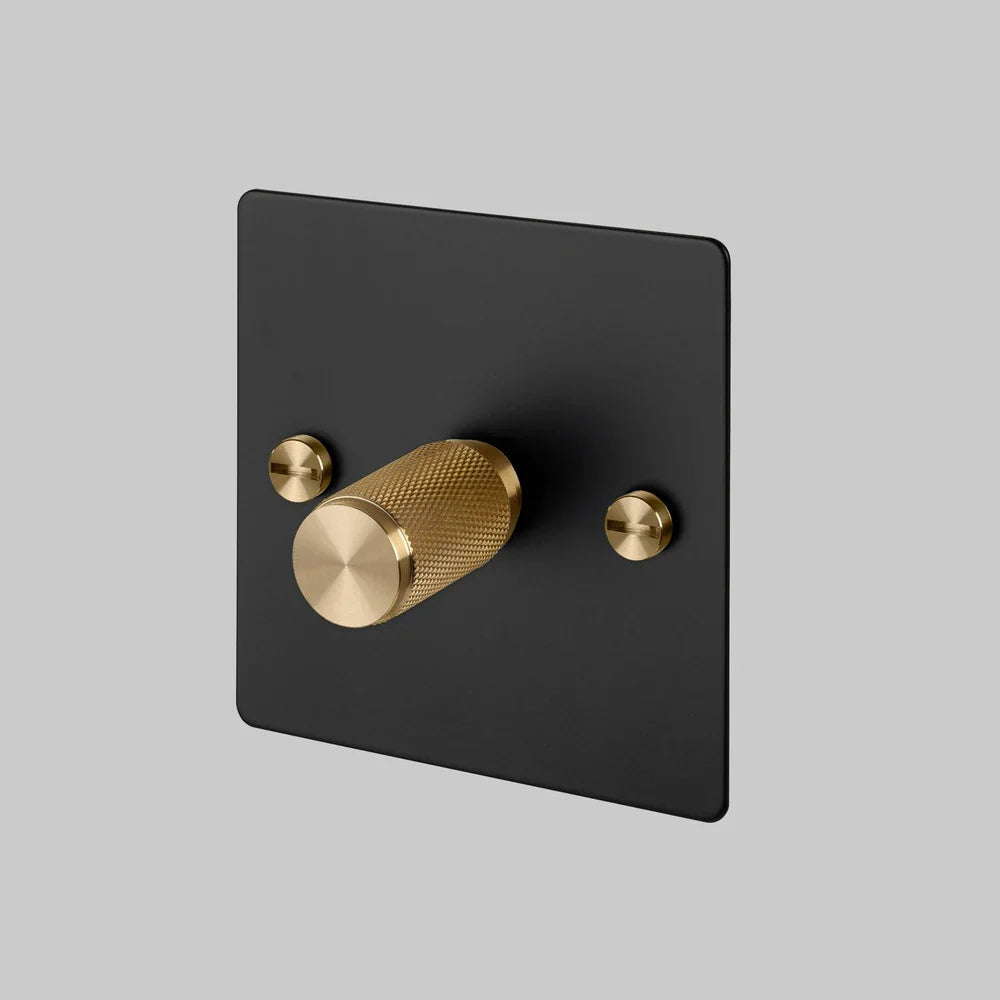
The Buster + Punch 1G Dimmer Switch is a good example of what a properly matched modern dimmer looks like. It's rated to dim LED bulbs from 5 to 120W, or incandescent and halogen from 60 to 400W, on standard UK 230 to 240V wiring at 50Hz. The electronic soft start eases lights up from off rather than snapping straight to full brightness, and it's a two way switch rated at 10AX. It comes in Steel, Brass or Black finishes, and the same dimmer module is available as a 3G version for anyone running three separate lighting circuits behind one plate.
If you've got downlights fed from a grid plate rather than a standalone switch, the Collingwood 250W LED Mains Grid Dimmer does the same job in that format. It's rated for up to 10 compatible LED units on a single dimmer, built to BS EN 60669-2-1, and it has an adjustable minimum brightness setting so you can set exactly how low the dimmer will go before the LEDs start to flicker or drop out, rather than guessing. It needs a pattress box at least 35mm deep and carries a 1 year warranty.
Before buying a new dimmer, check the maximum load. A 1G Buster + Punch dimmer handles LED loads from 5 to 120W. If you're running ten 10W LED downlights on one circuit, that's 100W, close enough to the ceiling that it's worth stepping up to a 3G module or a grid dimmer rated for the number of fittings rather than the wattage alone.
Part 3: A Failing or Mismatched LED Driver
If the flickering is coming from an integrated downlight, a strip light, or any fitting where the LEDs don't have a visible bulb you can just swap out, the problem is more likely to be the driver rather than the light source itself. The driver converts your mains AC supply into the steady low voltage DC current the LEDs actually need. When a driver is failing, underpowered for the load it's running, or simply the wrong type for how the circuit is controlled, the result shows up as flicker.

A driver like the Collingwood DRV150700 is a constant current design rated at 30W, taking a 220 to 240V AC mains input and running at around 89% efficiency. Its output is selectable between 150mA, 250mA, 350mA, 500mA or 700mA via a dip switch, with a 5 level lumen selection built in, so it can be matched precisely to the LED load it's feeding rather than left to run at a mismatched current that shortens component life and causes exactly the kind of flicker we're covering here. It's IP20 rated for dry, protected locations such as a ceiling void, and carries a 5 year warranty.
Driver type matters just as much as driver quality. Some fittings are built to run on mains dimming, others on 1 to 10V or DALI control signals, and pairing the wrong driver type with the wrong dimmer is a common cause of flicker even when both components are individually fine. The Collingwood 1901 Trimless Downlight is available with Mains Dimming, 1 to 10V Dimming or DALI driver options built in, which is worth knowing if you're specifying a new downlight run rather than just replacing a bulb, since the driver has to match the control method you actually intend to use.
| Symptom | Likely cause | What to check or replace |
|---|---|---|
| Bulb flickers or buzzes on a dimmer, especially at low brightness | Non dimmable LED bulb | Swap for a bulb marked dimmable |
| Dimmable bulb still flickers, limited dimming range | Old leading edge dimmer not matched to LED | Fit a dimmer designed for LED loads |
| Integrated downlights or strip lighting flicker, no bulb to check | Failing or mismatched driver | Replace the driver, matched to load and control type |
| Flicker gets worse over weeks, bulb dims permanently | Bulb reaching end of life | Replace the bulb |
| Flicker only when kettle, fridge or motor switches on | Voltage fluctuation or shared circuit interference | Electrician check on circuit loading |
| Flicker after recent works, or lights that dim unexpectedly | Loose connection or overloaded circuit | Electrician inspection, never DIY on wiring |
| Whole property flickers, neighbours report the same thing | Local power grid fault or planned works | Contact your electricity network operator |
Part 4: Loose Connections and Wiring Issues
A loose bulb, a loose connection at the fitting, or a poor connection in the ceiling rose or junction box will all cause flickering, and it's often intermittent rather than constant, which makes it easy to mistake for a bulb or driver fault. If the flicker changes when you tap the fitting, jiggle the bulb, or only happens when a door slams nearby, a loose connection is the more likely explanation.
Start with the simple check: make sure the bulb is screwed or clicked in fully. If that doesn't fix it, the issue is inside the fitting or the wiring behind it, and that's not a DIY job. Loose connections in mains wiring are a genuine safety issue as well as an annoying one, so this is where you call a qualified electrician rather than keep swapping bulbs.
Part 5: Voltage Fluctuations and Overloaded Circuits
If your lights flicker in sync with a large appliance switching on, a kettle, a washing machine motor, an immersion heater, that's usually a voltage drop on a shared circuit rather than anything wrong with the light fitting itself. High draw appliances pull a sudden surge of current, and if your lighting circuit shares supply with them, or the circuit is simply carrying more load than it's comfortably rated for, you'll see a brief dip that shows up as a flicker.
This is also worth checking if the flickering affects every light in a room or across the whole house at once, rather than a single fitting. Whole property flickering points toward the incoming supply, the consumer unit, or genuine overloading rather than a bulb or dimmer problem, and it's worth an electrician's assessment rather than working through the bulb checks above.
Part 6: The Bulb Is Simply Reaching End of Life
LED bulbs don't tend to blow instantly the way an old incandescent filament does. More often they degrade gradually, and flickering, dimming, or a colour shift in the last weeks of a bulb's life is completely normal. If a single bulb in a multi bulb fitting has started flickering while the others are steady, and it's been in use for a long time, replacing that one bulb is usually the fix rather than anything more involved.
Part 7: Smart Bulbs and Hub Sync Issues
Smart bulbs add a layer that standard LEDs don't have: a wireless connection to a hub or app. Flickering on a smart bulb can come from everything covered above, but it can also come from a weak WiFi or Zigbee signal, a firmware update stalling mid dim, or the bulb losing sync with its hub during a scene change or schedule trigger. If a smart bulb flickers only when controlled through the app, and behaves normally on a manual switch, the connection is the more likely culprit rather than the bulb itself.
Part 8: Mains Interference from Other Devices
Dimmer switches work by rapidly switching the mains supply, and that switching can generate a small amount of electrical noise on the circuit. Certain devices, particularly older dimmers without proper interference suppression, cheap LED drivers, or electrical equipment with motors nearby, can interact with each other and cause flicker that isn't obviously tied to any one component. This is one of the less common causes on this list, but it's worth knowing about if you've ruled out the bulb, the dimmer and the driver individually and the flicker persists.
Part 9: A Problem with the Wider Power Supply
Occasionally the cause isn't in your home at all. A fault or fluctuation on the local power grid, or planned works on the network near you, can cause flickering that affects your whole property and nothing you check indoors will explain it. This is the least common cause on this list, but it's worth ruling in or out if every other check has come back clean.
The simplest way to check is to ask a neighbour whether they're seeing the same thing. If they are, the problem sits with the incoming supply rather than your wiring, and it's worth contacting your electricity network operator (not your energy supplier, though they can usually point you to the right number) to ask whether there's a known fault or planned work in the area.
Frequently Asked Questions
Why do my LED lights flicker on a dimmer switch?
The most common reason is a non dimmable LED bulb fitted to a dimmer circuit. LED bulbs need internal circuitry specifically designed to respond to a dimmer's signal, and a non dimmable bulb simply isn't built for it. Check the bulb packaging states it's dimmable, and if it does, check the dimmer switch itself is rated for LED loads rather than an old model built for halogen.
Can an incompatible bulb damage my dimmer switch or fitting?
Running a non dimmable LED on a dimmer circuit for a long period can shorten the life of both the bulb and the dimmer, since neither is working the way it was designed to. It's not usually an immediate safety issue, but it's worth fixing the mismatch rather than living with it.
How do I know if a bulb is dimmable?
Check the packaging or the product page. Dimmable LED bulbs are labelled as such, and non dimmable versions of the same bulb are labelled non dimmable too, often at the same or a very similar price. There's no visual way to tell them apart, so the label is the only reliable check.
My lights flicker even though there's no dimmer switch involved, what's causing that?
Without a dimmer in the circuit, the likely causes are a loose connection, a bulb reaching the end of its life, a failing driver in an integrated fitting, or a voltage fluctuation from another appliance on the same circuit. Whole house flickering, or flickering that coincides with another appliance switching on, points toward the electrical supply rather than the light fitting.
Is flickering a fire risk or something to worry about?
Occasional flicker from a bulb dimmable mismatch isn't a fire risk. Flickering caused by a loose connection or a wiring fault can be, since a poor connection generates heat. If tightening the bulb doesn't resolve it, or the flicker started after other electrical work, get it checked by a qualified electrician rather than assuming it's just the bulb.
Why do my lights flicker when I turn on the kettle or another appliance?
That's a voltage drop caused by the appliance drawing a sudden surge of current on a shared circuit. It's common in older properties or where a circuit is carrying more load than it was originally designed for, and it's worth an electrician's assessment of circuit loading rather than a bulb swap.
Do smart bulbs flicker for different reasons than standard LED bulbs?
They can. Alongside every cause covered above, smart bulbs can flicker due to a weak wireless connection to their hub, a firmware update, or a sync issue during a scene or schedule change. If the flicker only happens through app control and not on a manual switch, the connection is the more likely cause.
More Things Worth Knowing
Why does flickering only happen at low dimmer settings?
This is the clearest sign of a dimmer and bulb mismatch. LED drivers need a minimum current to stay stable, and if the dimmer isn't cutting the waveform in a way the driver can follow smoothly, the low end of the dimming range is where it shows up first. A dimmer with an adjustable minimum brightness setting, like the Collingwood grid dimmer covered above, lets you set the floor above the point where flicker starts rather than living with it.
Does every fitting on a dimmer circuit need to be dimmable?
Yes. If a dimmer switch controls several bulbs and even one of them is non dimmable, that bulb is likely to flicker or fail early, and it can affect how the whole circuit behaves. When replacing bulbs on a dimmed circuit, replace all of them with matching dimmable versions rather than mixing types.
Can I fix a flickering downlight myself, or does it need an electrician?
Swapping a bulb is the one part of this you can safely do yourself. Everything past that, replacing a driver, fitting a new dimmer switch, or working on the fixed wiring, ceiling rose or a junction box, should go to a qualified electrician. Isolating the power safely isn't always as obvious as switching a light off at the wall, a fitting can still be live from another circuit or a shared neutral, so it's not a risk worth taking as a DIY job. UK wiring regulations also require certain work to be signed off by a qualified electrician.
Got a flickering light you can't get to the bottom of?
Browse our full range of dimmer switches and dimmable LED bulbs, matched and tested to work together properly.
Or call our experts: 020 8925 8639


Leave a comment
This site is protected by hCaptcha and the hCaptcha Privacy Policy and Terms of Service apply.